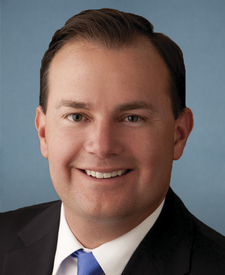
Senator for Utah
Mike Lee
On 4 of 6 issues where both are on record, Lee voted the way they spoke. When control of the Senate changed, their position moved on 1 of 4 issues. They vote apart from the Republicans more often than 96% of ranked senators.
On consistency against party peers they could rank anywhere from 1st to 63rd of 72. See the full ranking.
The three measures
Where Lee sits among all ranked senators
Each tick is one ranked senator. The grey bar is the median for Republicans.
Votes match own words
How closely their votes line up with what they said, issue by issue. 100 means every counted vote went the way they said.
Holds position when power changes
Compares their position while their party ran the Senate with their position while it did not. 100 means no change.
Votes apart from party
How far their votes sit from their caucus's average on the same roll calls. Descriptive only: neither high nor low is better.
Issue by issue
What they said, and how they voted
Issue match = 100 × (1 − gap ÷ 2). The headline score combines issues by how much evidence each has, then pulls thin records toward the Senate average. How every point is added.
When power changed
Their position in the minority, and in the majority
Issues where they have at least two records from each side. An arrow means the position moved when their party's status changed.
Every record
100 dated records, 2013 to today
Above each line: toward the issue's first position. Below: toward the opposite. Hover any mark for the record; click to open the source.
In their own words
Verified floor statements
Each quote was read from the Congressional Record and checked word for word against the page it came from.
“This shutdown has gone on long enough. This shutdown should come to an end, and it should come to an end by the very generous offer made by Republicans time and time and time again to continue at spending levels that, until just months ago, were the Democrats' own spending levels.”
“That is why I stand in full wholehearted support of Senator Rand Paul's joint resolution of disapproval to block this misguided, dangerous, reckless, wealth transfer to a corrupt foreign government. I call on all of my colleagues to do the same.”
“Mr. President, this motion calls for a full-year CR. Let me tell you what a full-year CR taking us to September 30--if we were to go to a full-year CR, one taking us to September 30, we would save $130 billion.”
“This worked like a dream. This dramatically reduced illegal border crossings.”
“Obviously, we need to keep the government funded. We don't want a shutdown. No one wants a shutdown.”
“If the filibuster were removed, everything from regulatory structures to tax rates, the size of the Supreme Court, the makeup of the military, the criminal code, and much, much more could change drastically every few years.”
“Instead of Democrats and Republicans working together to find consensus on the appropriate way to raise the debt ceiling, likely in exchange for spending reforms, some combination of Senate and House leadership concocted a new mechanism.”
“it is time to repeal the 2002 AUMF and bring our troops in Iraq home. It is also time to repeal the 2001 AUMF and bring our troops in Afghanistan home.”
“That is the concern I have with this deal. That is the reason I plan to vote against it.”
“What this resolution does is very simple. It says that short of the U.S. Congress's declaring war or authorizing the use of military force in the civil war in Yemen, half a world away, we shouldn't be there, and we should get out. I strongly urge my colleagues to support this resolution.”
“That is precisely why it is unconstitutional and morally bankrupt for us to get involved in a war without the people's elected representatives in Congress voting to do so, without our having the ability to debate it, to discuss it, and to vote affirmatively to put our brave young men and women in harm's way to engage in that war.”
“We need to dispense, once and for all, with this mindset that says we are going to fund the government with one bill. You are going to have one opportunity to vote on any and all matters relating to the funding of the Federal Government.”
Showing 12 of 24; the timeline above has every one.